 Ashoka

Claire Fallender
Claire Fallender is a Leadership Group Member at Ashoka and currently serves as Interim Director for Latin America while leading Ashoka's global youth strategy to help ensure that all young people can thrive in a rapidly changing world as changemakers. Throughout her career, Claire has been driven by a deep commitment to justice, fairness, and the belief that everyone has the potential to create positive change. Her trajectory was strongly shaped by her parents: a mathematician mother who challenged gender norms and later became a community leader in public education, and a business executive father whose international work exposed Claire to diverse cultures and perspectives. Together, they instilled in her a profound sense of fairness and confidence that she could make a difference.
Claire's changemaking journey began in high school, where she led her school's social change organization and coordinated student initiatives focused on housing, health, and social justice. Early volunteer experiences in Honduras taught her the importance of community-led solutions and the unintended consequences that can arise when outsiders drive change without local ownership. At Yale College, Claire continued to advance social justice causes, launching the Students Against Sweatshops campaign after witnessing labor violations while interning with a garment workers' union in New York. The campaign successfully persuaded Yale to adopt a Code of Conduct governing the ethical sourcing of licensed products. During a study-abroad experience in Chile, she encountered an Ashoka Fellow whose approach to systems change deeply shaped her understanding of how people closest to a problem are often best positioned to solve it. Inspired by this experience, Claire joined Ashoka after graduation.
Over the course of her career at Ashoka, Claire has worked across nearly every level of the Venture and Fellowship program, Ashoka’s flagship initiative to find, support and connect social entrepreneurs addressing the world’s most urgent problems. After starting in Washington, DC, she moved to Brazil, where she led the Fellowship program and co-designed Ashoka Brazil's first youth changemaking initiative with a Brazilian Ashoka Fellow. Seeking to deepen her understanding of the intersection between social innovation and public policy, she left Ashoka in 2004 to earn a Master of Public Affairs from Princeton University's School of Public and International Affairs. During this period, she worked with UNICEF to develop the first inter-agency guidelines across seven United Nations agencies for supporting adolescent girls.
Following Princeton, Claire joined Oikos-Cooperation and Development in Mozambique as Country Director, helping farmer and fishing cooperatives develop innovative responses to climate change and the HIV epidemic. Recognizing the limited support available to local social entrepreneurs, she returned to Ashoka to lead the Global Venture and Fellowship Program, overseeing the search, selection, and engagement of the world's largest network of leading social entrepreneurs.
In the past decade, Claire has worked across Ashoka's global network to develop strategy, systems, partnerships, and measurement tools that strengthen youth changemaking worldwide. Beyond her professional responsibilities, Claire is passionate about the care economy and volunteers to support policy efforts that support caregivers in Washington, DC. Claire enjoys hiking and crafting and is grateful for the support of her husband and two young sons.
What Leading Social Entrepreneurs Are Telling Us
Ashoka Fellow Kritaya Sreesunpagit of Thailand started her first social change initiative in high school, convincing her peers to help a community build a new reservoir. Ashoka Fellow Christoph Schmitz of Germany started his first social business at 12, growing Christmas trees on a plot of his family farm to benefit the local orphanage.
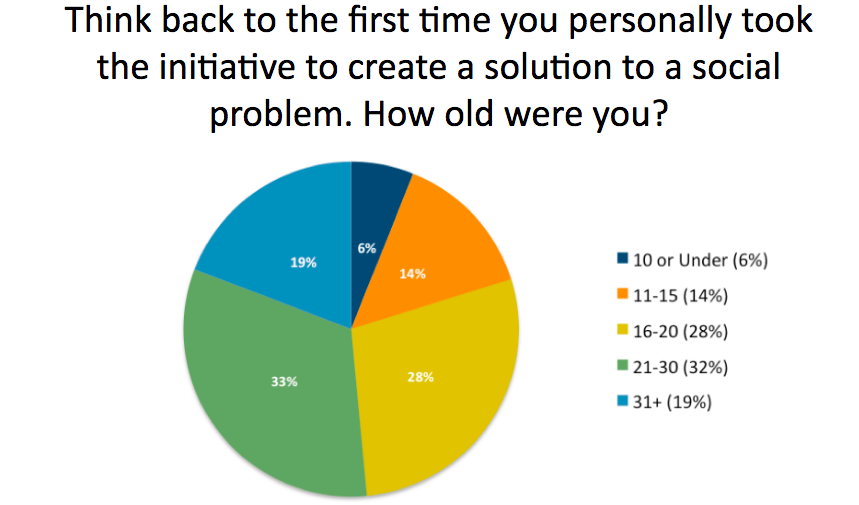
After running one of the largest and most diverse studies of system changing entrepreneurs ever collected this past spring, Ashoka now has the data to show that Kritaya and Christoph are not anomalies — nearly half of Ashoka Fellows had their first changemaking experience before the age of 21.
“[Early leadership opportunities] really form who you are,” says Sreesunpagit. “What you are exposed to during those years will form how you lead your life afterwards.”
This finding lies at the heart of Ashoka’s efforts to support young changemaking, and is a powerful call for why leading young should serve as the guiding principle for anyone who influences the education and development of young people.
Changemaking Has Become The “New Game”
Imagine the following scenario: you grew up playing baseball. For years you practiced batting, throwing the ball, and catching with a glove. But you show up to the field one day and instead of baseball, everyone is playing soccer. The team dynamics are different. The skills needed are different. Even the pace of the game has quickened. If you try to play without have the skills or knowing the rules, you’ll probably be taken out of the game.
This is what a large portion of people around the world are feeling today: they’ve woken up and the game has changed. We no longer live in a world of repetition where you can learn a skill, trade, or profession and repeat it over and over. Instead, the rate of change and the extent of connectivity is increasing exponentially. According to a report published in 2017 by Dell Technologies, 85 percent of jobs in 2030 haven’t been invented yet.
Problematically, our institutions are still largely rooted in the past. Schools continue to focus on GPA and standardized test scores as the primary indicators of “success.” Schools and the wider education system need to find a new definition of success -- a definition that is centrally about empowering young people as empathic changemakers, who live for the common good. New policies, assessments, teacher training programs, and other systemic mechanisms will be vital, but just as important is the need to change mindsets.
What We’ve Learned: How to Nurture Changemaking
So how do we build a society that supports young people to practice changemaking? We can look to Ashoka Fellows’ childhood experiences to see how it’s done.
Create an environment that encourages questioning, debate, creativity, and positive action
Growing up, Fellows were encouraged to question the “status quo,” including existing societal norms and expectations, and to take creative action to solve problems around them. Usually, relatives or teachers gave the Fellow the support and encouragement they needed to take risks and start something they cared about. Fellows often mentioned their parent's own career or lived experience (sometimes as educators, psychologists, or as members of marginalized groups, like refugees) as influencing their focus on social impact and in developing a "can do" entrepreneurial mindset. Fellows also specifically mentioned their family's emotional support as a significant factor in their development as a changemaker.
Trust and encourage young people to take responsibility and leadership roles
Fellows were encouraged by their families and teachers to join other people’s initiatives at a young age. This gave them opportunities to explore their passions and to take responsibility and leadership roles. Contributing to other peoples’ initiatives gave them the opportunity to practice building teams and leading in a way that empowers others. Leadership could mean helping out with the family business, taking on responsibility with community and faith-based organizations, or being part of a leadership group at school.
Increase young people’s exposure to individuals, communities, cultures and ideas that are different from their own
The third most common experience that Fellows said was important for leading young was exposure to individuals, communities, cultures, and ideas that were very different from their own. Some of these experiences involved trips or families moving to a new country that turned the Fellow into an "outsider" in their new environment. Fellows explained that this experience of being an outsider enabled them to see social structures and problems more clearly, and to gain empathy for populations they previously had not encountered.
Ashoka Fellows Are Showing Us A World Where Everyone is Powerful
Ashoka Fellows have been leading this movement to empower people as changemakers for nearly 40 years. Based on our recent Fellows survey, we have learned critical insights for everyone around the world involved in supporting young people, which can easily be summed up as: young people need powerful learning experiences through which they become empathic, face up to the world’s problems, find their purpose, take the lead, and work with others in creatively solving those problems. Given the challenges we face locally and globally, we believe there is nothing more urgent for the future.
Note: A version of this article first appeared in the Social Innovations Journal on November 30th, 2018.