
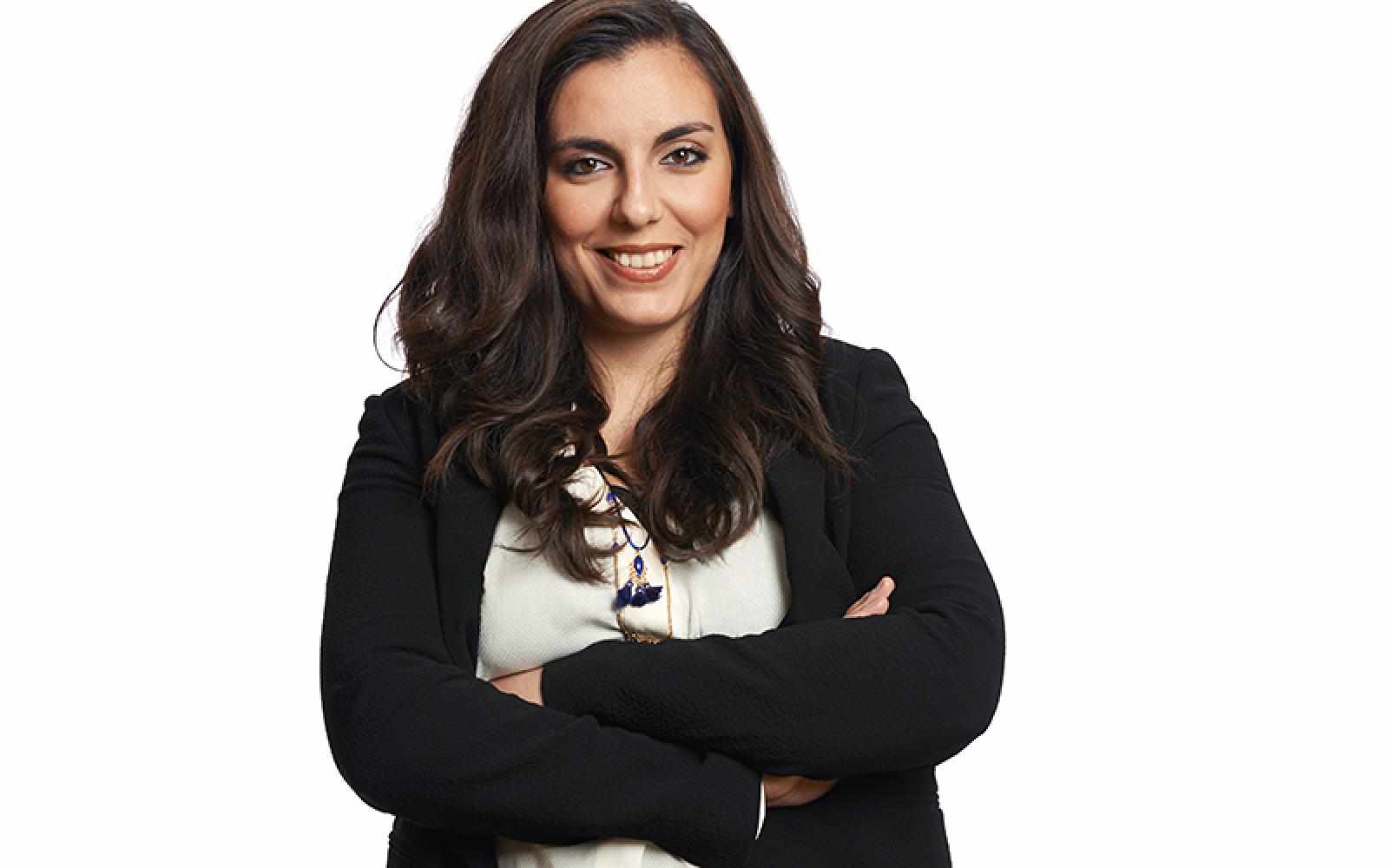
Claire Fallender
Claire Fallender is a Leadership Group Member at Ashoka and currently serves as Interim Director for Latin America while leading Ashoka's global youth strategy to help ensure that all young people can thrive in a rapidly changing world as changemakers. Throughout her career, Claire has been driven by a deep commitment to justice, fairness, and the belief that everyone has the potential to create positive change. Her trajectory was strongly shaped by her parents: a mathematician mother who challenged gender norms and later became a community leader in public education, and a business executive father whose international work exposed Claire to diverse cultures and perspectives. Together, they instilled in her a profound sense of fairness and confidence that she could make a difference.
Claire's changemaking journey began in high school, where she led her school's social change organization and coordinated student initiatives focused on housing, health, and social justice. Early volunteer experiences in Honduras taught her the importance of community-led solutions and the unintended consequences that can arise when outsiders drive change without local ownership. At Yale College, Claire continued to advance social justice causes, launching the Students Against Sweatshops campaign after witnessing labor violations while interning with a garment workers' union in New York. The campaign successfully persuaded Yale to adopt a Code of Conduct governing the ethical sourcing of licensed products. During a study-abroad experience in Chile, she encountered an Ashoka Fellow whose approach to systems change deeply shaped her understanding of how people closest to a problem are often best positioned to solve it. Inspired by this experience, Claire joined Ashoka after graduation.
Over the course of her career at Ashoka, Claire has worked across nearly every level of the Venture and Fellowship program, Ashoka’s flagship initiative to find, support and connect social entrepreneurs addressing the world’s most urgent problems. After starting in Washington, DC, she moved to Brazil, where she led the Fellowship program and co-designed Ashoka Brazil's first youth changemaking initiative with a Brazilian Ashoka Fellow. Seeking to deepen her understanding of the intersection between social innovation and public policy, she left Ashoka in 2004 to earn a Master of Public Affairs from Princeton University's School of Public and International Affairs. During this period, she worked with UNICEF to develop the first inter-agency guidelines across seven United Nations agencies for supporting adolescent girls.
Following Princeton, Claire joined Oikos-Cooperation and Development in Mozambique as Country Director, helping farmer and fishing cooperatives develop innovative responses to climate change and the HIV epidemic. Recognizing the limited support available to local social entrepreneurs, she returned to Ashoka to lead the Global Venture and Fellowship Program, overseeing the search, selection, and engagement of the world's largest network of leading social entrepreneurs.
In the past decade, Claire has worked across Ashoka's global network to develop strategy, systems, partnerships, and measurement tools that strengthen youth changemaking worldwide. Beyond her professional responsibilities, Claire is passionate about the care economy and volunteers to support policy efforts that support caregivers in Washington, DC. Claire enjoys hiking and crafting and is grateful for the support of her husband and two young sons.
Sarah Toumi: Leading change in rural areas of Tunisia since the age of 11
Starting your journey as a changemaker in your teens sticks with you for a lifetime. Whether it is solving a problem affecting your family or close friends or something much larger affecting your community, the experience helps you know that whatever the world throws your way, you are a giver, you are powerful, you are a changemaker. That confidence will stay with you throughout your life.
Climate change mitigator and Ashoka Fellow Sarah Toumi’s story of starting her changemaking journey at 11 shows this link: that in a world of rapid change where following the rules is no longer enough, success means being a changemaker and the earlier you start the better.
Sarah Toumi, a French-born Tunisian woman, spent much of her childhood with her extended family in Bir Salah, Tunisia. During one visit, she remembers sharing with her cousins her dream of becoming an astronaut when she finished school. She then asked them about their dreams. Her three cousins, all girls, said that they were dropping out of school because there was no bus to take them. The high school was 12 km away and it was too dangerous to go by foot. Sarah remembers thinking, “How is that possible? I can become what I want because the school is close by and everything is possible for me.” There had to be a way to get a bus for them. Sarah enlisted her father’s support and set up her first organization—helping children in her family’s village and beyond have access to learning opportunities in and outside of school. She was 11 years old.
Within four years, Bir Salah had a bus to take kids to school and seven years after that, they had their own high school.
Now 29, Sarah is leading Acacias for All, a movement to curb desertification in rural communities across Tunisia. She introduces alternative crops, like Acacia trees, to help farmers increase their income while restoring the quality of the soil. Sarah’s initial program in Bir Salah with 300 farmers and rural craftswomen resulted in an average 60% increase in income. She is now expanding to half of Tunisia’s provinces with 100,000 trees planted. Sarah’s aim is to change the way farmers and policy leaders approach climate change mitigation, taking it from a low-priority, costly endeavor to a core strategy for improving rural livelihoods.
What made it possible for Sarah to do this? Sarah’s early changemaking experience was critical to her success today. “When you start early, you learn how to work with others and solve problems... I didn’t know I was a ‘changemaker,’ but I was sure I was going to be an actor of change.” From an early age, Sarah’s parents involved her in their own purpose-driven work.“It was normal for us to take time for others,” Sarah remembers.
“We didn’t always understand everything but we had exposure.” Her teachers also gave her the space to be creative and curious, encouraging her to do extracurricular research projects on topics she was interested in and present them back to the class.
By 15, Sarah began to think beyond her family’s village. She saw the impacts of climate change and began to develop her broader plans, in part helped by Ashoka’s Youth Venture.
Today, all of Sarah’s younger cousins are in school, including several who attend universities. Sarah has taken one cousin in particular under her wing, involving him in meeting with rural communities and accompanying her when she speaks at youth forums.
According to Sarah, it is critical to give young people today the kind of exposure and support that her parents and teachers gave to her. “For those who think that their children will become successful if they simply become a doctor or lawyer, they are wrong. Their children will be completely out of the game.”
Sarah sees the world her young cousins are growing up in as unstable and frightening at times with extremism, terrorism and climate change. “But young people have the ability to dream without constraints. They are connected, have access to information, can travel and talk to people who are different, and talk across continents. What they need is support from my generation and older to gain the skills and motivation to believe in themselves, do things and try.”