 Ashoka
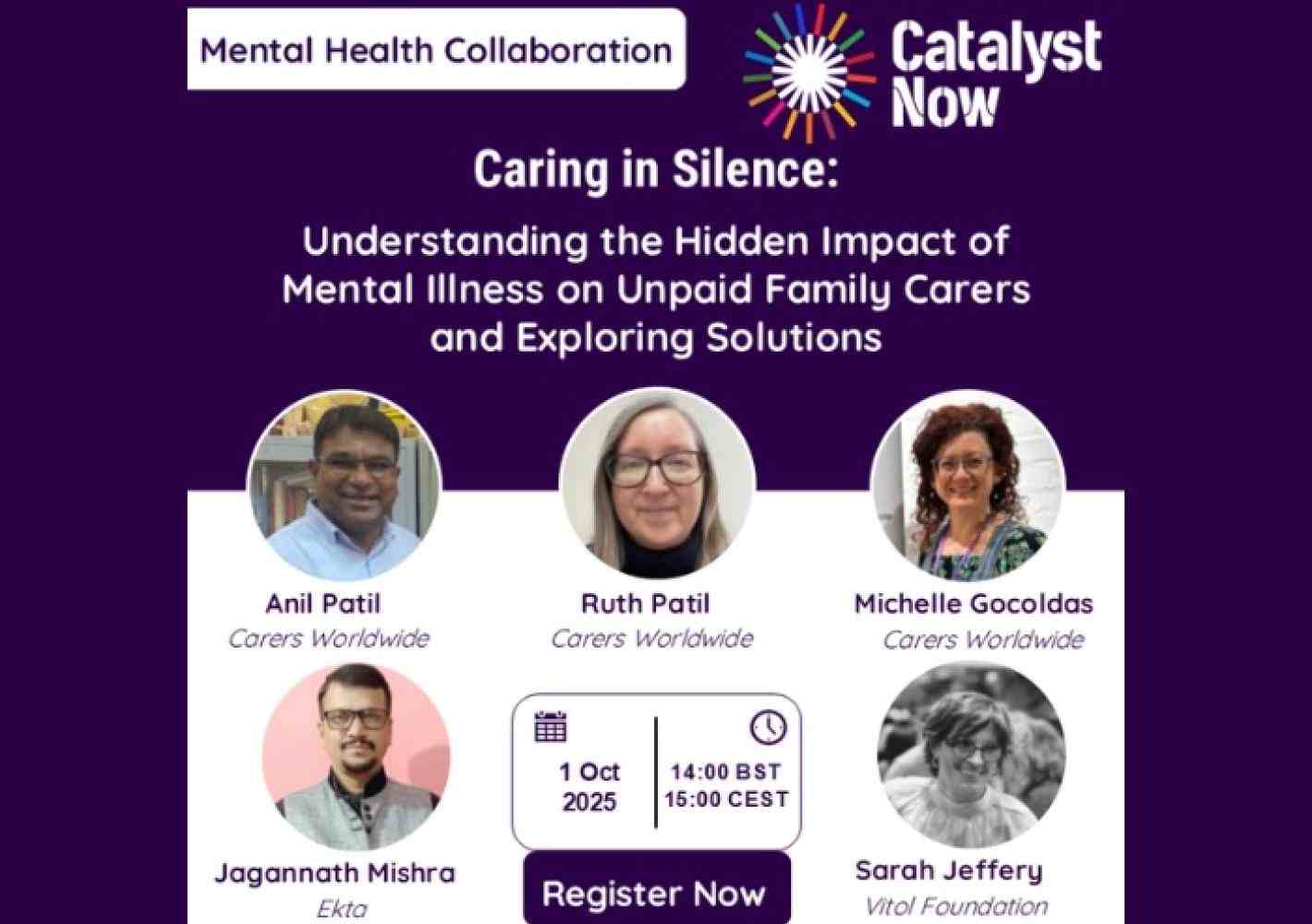
Catalyst Mental Health Collaboration Webinar: Understanding Family Carers and Exploring Solutions
The impact of caring is huge. Carers experience social stigma and are isolated, their own physical and mental health is affected, and many of them are unable to work, which impacts their families economically. Carers are often unrecognised and unsupported by their communities and governments.
Join Carers Worldwide for this webinar, where they will discuss the benefits of recognising and supporting the mental health of unpaid family carers, both for the carers themselves and their families and communities. During this webinar, you will learn from one of their partners in India about the impact that including carers in their programmes has had; hear from a carer in Bangladesh who has trained to become a Barefoot Counsellor and now supports other carers with their mental health; and discover key actions and takeaways that you can implement to support carers in your own sphere of influence.
Join Anil Patil, Ruth Patil, Michelle Gocoldas, Jagannath Mishra, and Sarah Jeffery for this session!
Speakers
Anil Patil, Founder & Executive Director, Carers Worldwide
Anil Patil has nearly 30 years of experience in international development as a practitioner, grant-maker, and trustee. In 2012, drawing on both professional and personal insights, he founded Carers Worldwide, the only international NGO dedicated exclusively to unpaid family carers in low- and middle-income countries.
Under his leadership, the organisation has transformed the lives of more than 250,000 carers and their families across India, Nepal, and Bangladesh - supporting their social, physical, mental, and economic well-being, while driving systemic change at policy and community levels. Anil is also Interim Chair of the Membership and Engagement Working Group of IACO (International Alliance of Carer Organisations) and was elected an Ashoka Fellow in 2015. Passionate about justice and equity, he is committed to making carers visible worldwide, influencing policy and practice, and ensuring carers’ rights are recognised in national legislation. His vision is a thriving global carers’ movement where carers are recognised, supported, and empowered.
Ruth Patil, Development Director, Carers Worldwide
Ruth Patil is the Development Director at Carers Worldwide. With a background in disability, health, and international development and almost 30 years’ experience in the sector, Ruth’s role encompasses partnerships, programme development, income generation, and strategic growth. She is also an experienced trainer and a qualified speech and language therapist. As an unpaid carer herself for her daughter with Down syndrome, she is passionate about creating inclusive systems that recognise and support unpaid carers as vital members of society.
Ruth has played a key role in expanding Carers Worldwide’s work across India, Nepal, and Bangladesh, ensuring that carers’ voices are heard and their needs addressed through innovative, community-led solutions and impactful advocacy.
Michelle Gocoldas, Communications and Supporter Engagement Manager, Carers Worldwide
Michelle Gocoldas is the Communications and Supporter Engagement Manager at Carers Worldwide, where she leads on amplifying the organisation’s mission and building meaningful connections with supporters. With over 15 years of experience in communications, social media, and digital marketing, Michelle has worked in Europe and Asia, helping businesses and non-profits strengthen their digital presence and engage diverse audiences.
Her career is defined by a passion for storytelling and creating impact through clear, accessible communication. Beyond her work in communications, Michelle is also a qualified English Language teacher and has lived and taught English in Europe, Latin America, and Asia, an experience that deepened her cross-cultural understanding and ability to connect with people from all walks of life. At Carers Worldwide, Michelle is responsible for all online and offline communications, as well as managing the relationships with the charity’s individual donors. Michelle has developed and strengthened the charity’s brand, grown its online presence, and expanded its individual giving programme.
Jagannath Mishra, Secretary, Ekta
Jagannath Mishra is the Secretary of Ekta, a leading non-profit organisation working in Koraput, Odisha, for the past three decades. He holds a Postgraduate degree in Odiya Literature and has devoted his professional life to the empowerment of Adivasi and marginalised communities.
Under his leadership, Ekta has been at the forefront of initiatives on sustainable livelihoods, climate change adaptation, community health, child rights, inclusion of persons with disabilities & their carers, and disaster response. With more than 30 years of experience in the development sector, Jagannath has been instrumental in building strong community-based institutions and advocating for policies that uphold the rights and dignity of excluded groups. Widely respected as a grassroots leader and development practitioner, he continues to play a catalytic role in promoting participatory approaches and cultural preservation while fostering inclusive and sustainable development in Adivasi regions of Odisha.
Sarah Jeffery, Head of Health Portfolio, Vitol Foundation
Sarah Jeffery strategically manages the health portfolio at the Vitol Foundation and has been doing so since 2014, investing in mental health since 2019 in low- and middle-income countries. The Vitol Foundation prioritises community-based solutions that support the health and wellbeing of marginalised adolescents, including the communities that support them. Sarah holds a BA in International Relations and Development Studies, a BSc in Nursing, and an MSc in Public Health in Developing Countries from the London School of Hygiene and Tropical Medicine.
About Catalyst 2030: Mental Health Collaboration
The Catalyst 2030: Mental Health Collaboration creates opportunities for global collaboration between funder networks and mental health social entrepreneurs with tangible tools and resources to create a systemic impact.
The collaboration seeks to educate funders, social innovators, corporates, and policymakers on the intersectionality of mental health with other social justice systems. These include gender, climate change, education, healthcare, etc., to enhance cross-sector collaborations to integrate mental health work into other social justice issues.