 Ashoka
Taha Tariq
Taha Tariq is a sophomore at Dartmouth College studying Geography and Middle Eastern Studies with a minor in Human-Centred Design. A member of Ashoka UK’s Youth Changemaker Network, he is passionate about educational inequality, ranging from presenting research on T-Levels at Imperial College London to supporting campaigns on the importance of careers education with Teach First and Action for Race Equality. At Dartmouth, he is deeply involved in student advocacy as an elected Senator in Dartmouth Student Government and a member of the Student Advisory Board, where he works to ensure first-generation/low-income, international, and Muslim student needs are represented in campus decision-making. He is also a recent winner of the Great Initiative Award at Dartmouth, Vice-President of the Muslim Student Association, Co-Chair of the West-House Council and a photographer for the college newspaper, 'The Dartmouth.' At Ashoka Arab World, Taha serves as a Fellowship and Venture Intern, supporting the search for new Fellows while also contributing to storytelling and communications that spotlight the work of Ashoka Fellows and partners across the region.
Turning Adversity into Resilience: Where Low-Cost Meets Revenue Innovation
More often than not, it’s the case that social entrepreneurs spend a lot of time engaged in discussions surrounding “sustainability.” But in practice, sustainability is more than just a buzzword; it’s the consistent effort of keeping impact alive when grants end, crises hit, and the world changes faster than your budget can.
That’s exactly where collaboration becomes more than a nice-to-have. Ashoka’s Collaboration Grants are designed as a catalyst, not just a set amount of cash to “do a project,” but an intentional mission to learn from peers and build relationships that outlast a single deliverable.
Especially in the Arab region, sustainability resides at the intersection of two distinct realities: running efficiently and generating revenue without straying from the mission. One organisation may have the secrets of mastering one side; it’s rare to see both, and even rarer for two organisations to build a bridge between them.
This is the story of that bridge.
Two models, one shared ambition
The Moroccan Center for Innovation and Social Entrepreneurship (MCISE) and the Lebanese Association for Scientific Research (LASeR) both operate in the field of education, but within different ecosystems. When Adnane Addioui (Ashoka Fellow, Morocco) first connected with Dr Mustapha Jazar (Ashoka Fellow, Lebanon) through Ashoka gatherings years ago, the spark that formed wasn’t a shared crisis but a shared ambition.
As Adnane put it, the collaboration “didn’t come from a problem… it came from ambition”: to exchange institutional practices across two starkly different contexts. Just as important, it wasn’t meant to be an exchange between two Founders, but also included teams, creating a rare opportunity for staff to observe, compare and learn how “another sister organisation” works up close and bring back what is replicable.
Learning across borders
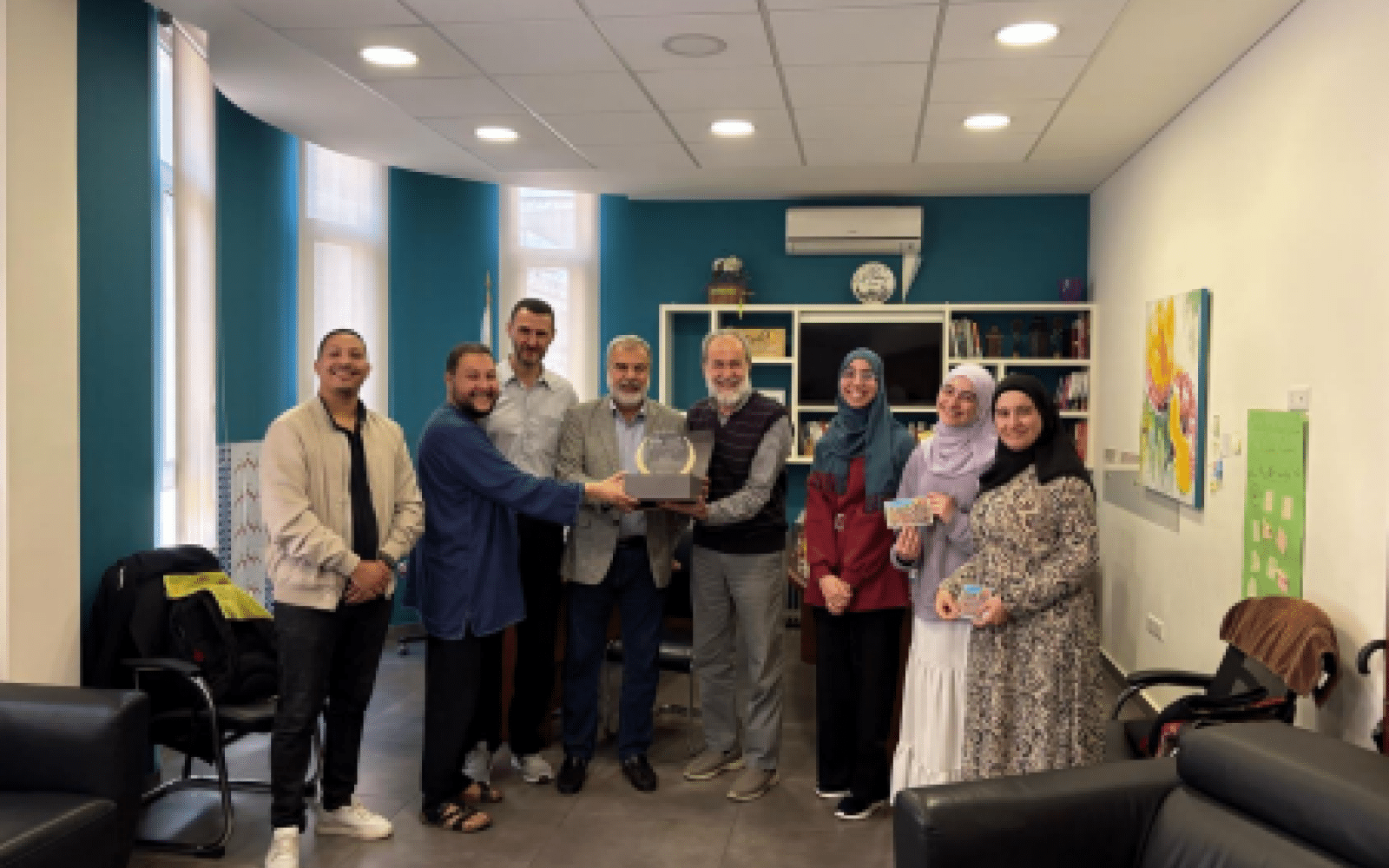
Through Ashoka’s Collaboration Grant, LASeR and MCISE had set out to learn from each other’s sustainability models in education. LASeR wanted to understand MCISE's cost-efficient programmes, whereas MCISE aimed to grasp LASeR’s innovative revenue-generating mechanisms and partnership strategies that help sustain their mission. In April 2025, three members of MCISE travelled to Tripoli, Lebanon, for an in-person exchange with LASeR, which entailed direct conversations with leadership and institutional deep dives into their programmes and spaces.
What they learned in Lebanon: “world-class” sustainability without compromise
Revenue innovation
LASeR offered two practical examples on revenue generation, the first was Masahet Nour, a 2000 m² community and coworking space, animated through events and workshops. It generates around $80,000 in annual profit, significant enough to help subsidise LASeR’s work dramatically. Adnane described it as “world class,” a reminder that NGOs don’t have to compromise quality to survive.
LASeR also built revenue tied to local constraints, exemplified through a solar panel installation project, which generates around $24,000 annually, turning an infrastructure challenge into a practical income stream.
Non-traditional partnerships
Another key takeaway was how LASeR leveraged nontraditional partnerships, such as their relationships with religious endowments and government actors. This demonstrates how public and faith-linked institutions can become enabling partners. In addition, LASeR described obtaining religious authorisation to direct Zakat towards education and refugee support, creating a long-term sustainable pathway connected to faith-based giving.
What’s important to note is that this exchange wasn’t one-directional. LASeR’s team was curious about how MCISE keeps programs so cost-efficient, especially how MCISE scales through partner delivery rather than delivering everything in-house.
Outcomes: what changed after the trip
For MCISE, the visit renewed a priority on rebuilding community infrastructure as a sustainable foundation. Having run a coworking space between 2015 and 2021, the team is now exploring how to bring back a hub that is adapted to the local context. The trip also resulted in widening MCISE’s scope on direct partnership building, prompting more intentional outreach to partners and funders.
For LASeR, the collaboration became even more crucial as new shocks hit and funding tightened. In that moment, the Collaboration Grant’s real value became apparent. As Adnane had explained, the grant wasn’t about the amount; it was “a baseline to make this relationship work.” Since the visit, the exchange has continued through follow-up conversations and practical peer support, including Adnane supporting LASeR by coaching them to develop an additional revenue stream for Masahet Nour, geared towards freelancers building on insights from the visit.
A bridge worth building
Lebanon and Morocco are not interchangeable. From regulation to infrastructure and political context, numerous factors shape what is feasible. Yet, this case study has shown that the most transferable insight from this collaboration is simple: resilience can be designed.
Or, in Adnane’s one-sentence summary of the grant’s value: “Learning how to make do with what you have – and creating a system of resilience.”
Ashoka’s Collaboration Grant is a small, flexible fund (up to $5,000) designed to help social entrepreneurs and Ashoka Fellows put their minds together to work on a short, practical collaboration that builds real capacity, not just a one-off activity. Teams are typically 2-4 people (with at least one Ashoka Fellow), must co-design and co-implement the work, and deliver it within 12 months. The grant can cover travel, research, training and producing shared outputs (e.g., reports, toolkit, etc.), with a focus on peer-to-peer learning, skills exchange and relationships that continue beyond the grant period.